 Psychology Roots
What Is Psychology?
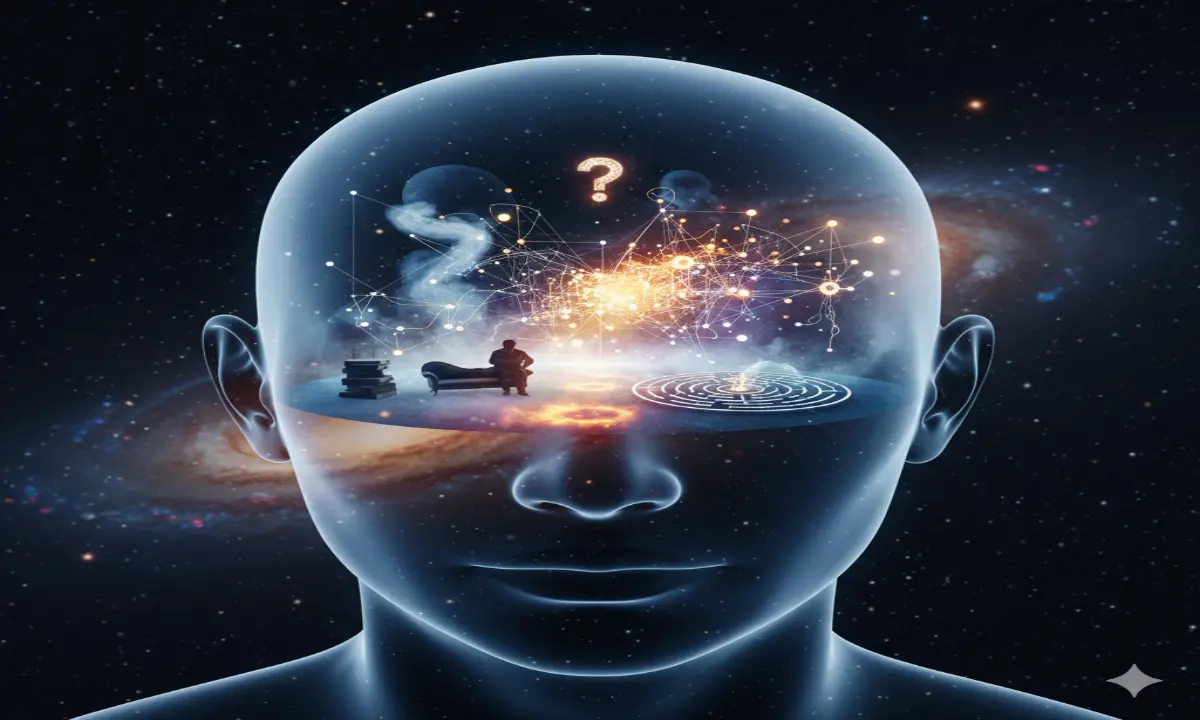
Have you ever caught yourself daydreaming on a crowded train, suddenly wondering why that random childhood memory surfaced just then? Or felt a wave of inexplicable anxiety before a big meeting, even though everything seemed fine? Moments like these remind us that beneath the surface of everyday life lies an intricate universe—the human mind. As a clinical psychologist with more than 15 years of practice, I’ve sat with countless people as they uncovered the hidden forces shaping their thoughts, feelings, and actions. And every single time, I’m humbled by how mysterious, resilient, and utterly extraordinary the mind truly is.
In many ways, psychology is the art and science of making sense of that inner universe. It’s the field that asks (and keeps asking) the questions we all secretly wonder about: Why do we do the things we do? How much control do we really have? And what happens when the mind breaks—and how can it heal?
If you’re curious about what psychology actually is, where it came from, and why it still matters today, you’re in the right place. Let’s take a warm, evidence-based stroll through its history, its big ideas, and why it remains one of the most integrative and human-centered sciences we have.
The Roots of a Young (Yet Ancient) Science
Long before anyone called it “psychology,” humans were already trying to figure themselves out.
More than 2,000 years ago, Aristotle insisted that the seat of consciousness was the heart (spoiler: he was wrong). Ancient Chinese civil service exams tested personality and intellect. In 9th-century Baghdad, the physician Rhazes ran what we would now recognize as an early psychiatric ward, treating mental illness with compassion instead of chains.
But modern scientific psychology didn’t truly begin until 1879, when Wilhelm Wundt opened the first formal psychology laboratory in Leipzig, Germany. Suddenly, the study of the mind had a home, experiments, and measurable data. From that tiny lab, an entire discipline exploded into life.
The Science of the Soul
The word psychology comes from the Latin phrase for the “study of the soul.” While that sounds poetic, the modern definition is a bit more grounded: the science of behavior and mental processes.
It’s a relatively young science. The formal discipline didn’t really kick off until the mid-1800s, but humans have been obsessed with what’s going on inside our heads since the dawn of time.
Long before we had MRI machines, we had curiosity. Aristotle, for instance, pondered the seat of human consciousness but famously bet on the wrong horse—he thought it resided in the heart, not the head. (We can forgive him; he didn’t have access to neuroimaging).
History is peppered with early attempts to understand our inner worlds. Two thousand years ago, Chinese rulers were already conducting the world’s first psychological exams, testing public officials on personality and intelligence. In the late 9th century, the Persian physician Rhazes was describing mental illness and treating patients in what was essentially the world’s first psychiatric ward in Baghdad.
We have always asked the big questions: Why do humans commit evil acts? do we have free will? What is the “self”?
While I may not have the answer to the meaning of life today, looking at how we tried to answer these questions gives us incredible insight into who we are.
The Early Schools: Three Different Lenses on the Same Mystery
In its first decades, psychology wasn’t one field—it was several competing visions of how best to study the mind.
Structuralism: Breaking Consciousness into Pieces
Wundt and his student Edward Titchener believed that if chemists could reduce matter to basic elements, psychologists could do the same with experience. They trained people to introspect—to describe exactly what they felt when smelling coffee or watching a sunset. The method was earnest, but ultimately too subjective. My sunset might evoke nostalgia; yours might trigger grief. Structuralism faded quickly because inner experience, beautiful as it is, resists being pinned down the way atoms do.
Functionalism: Why Does the Mind Do What It Does?
Across the Atlantic, William James asked a different question: not “what is consciousness made of?” but “what is it for?” Influenced by Darwin’s theory of evolution, functionalists studied how thoughts, feelings, and behaviors help us adapt and survive. James’s 1890 masterpiece, The Principles of Psychology, is still required reading in many graduate programs because it feels remarkably contemporary—he wrote about the stream of consciousness long before stream-of-consciousness novels existed.
Psychoanalysis: The Revolutionary Idea That the Unconscious Matters
Then came Sigmund Freud. Love him or (more commonly today) critique him, Freud changed everything. Watching his colleague Josef Breuer relieve a patient’s hysterical symptoms simply by letting her talk, Freud developed the “talking cure.” He proposed that much of human behavior is driven by unconscious motives—desires, fears, and conflicts we aren’t aware of yet that still shape our lives.
This was radical in 1900. The notion that mental illness could be healed through self-insight rather than confinement or restraint offered hope where almost none had existed. Freud’s legacy is complicated—many of his specific claims (penis envy, the universal Oedipus complex) have been debunked or heavily revised—but the core insight that unconscious processes influence us remains solidly supported by modern research (Westen, 1998; Bargh, 2017).
Behaviorism: If You Can’t Measure It, It Doesn’t Exist (For a While)
By the early 20th century, some psychologists grew impatient with anything unobservable. John B. Watson, Ivan Pavlov, and later B.F. Skinner argued that psychology should study only behavior—what we can see and record. Classical and operant conditioning showed that environments powerfully shape what we do. Behaviorism dominated mid-century research and gave us incredibly effective treatments (think exposure therapy for phobias or token economies in classrooms).
Yet it left something essential out: thoughts, feelings, meaning. As cognitive scientist George Miller famously quipped in the 1950s, treating the mind like a black box was like treating a radio as just wires and knobs—you miss the music.
The Integrative Science We Practice Today
Modern psychology is no longer a battleground of rival schools. Instead, it’s a big tent:
- Biological psychologists map brain circuits with fMRI.
- Cognitive psychologists study attention, memory, and decision-making.
- Humanistic psychologists (think Carl Rogers) emphasize empathy and self-actualization.
- Positive psychologists (Martin Seligman and others) research flourishing and resilience.
- Cultural and social psychologists remind us that context—family, society, history—matters enormously.
Today’s definition—“the scientific study of behavior and mental processes” (American Psychological Association, 2023)—honors all of these perspectives. We need rigorous experiments and brain scans, yes, but we also need the couch, the conversation, and the deeply human act of one person truly listening to another.
Why This Matters for You Right Now
Understanding psychology isn’t just academic. It’s practical self-knowledge.
When you recognize that a harsh inner critic might echo an old unconscious script, you can start rewriting it. When you learn how habits form (thanks, behaviorism!), you can design environments that make healthy choices easier. When you grasp that emotions often arrive before thoughts (LeDoux’s emotional brain research), you stop blaming yourself for “irrational” feelings and start working with them instead.
In short, psychology hands you tools—not to achieve a perfect mind (no such thing exists), but to live with greater awareness, compassion, and agency.
Final Thoughts: Your Mind Is the Cosmos in Miniature
Astronomers tell us the observable universe contains roughly two trillion galaxies. Yet many neuroscientists agree with the late astronomer Carl Sagan that the human brain—three pounds of wet, wrinkly tissue—is the most complex object we have ever encountered.
And you get to carry one around every day.
Psychology, at its best, is simply the disciplined curiosity we bring to that miracle. It’s the commitment to keep asking gentle, brave questions about why we hurt, why we love, and how we heal.
Reflection Question:
Think of a behavior or habit you have that seems “irrational.” If you applied the lens of Functionalism (asking “what purpose does this serve?”), what might you discover about yourself? Let me know in the comments below.
You’re not broken. You’re human. And that’s a pretty incredible place to start.
Help Us Improve This Article
Have you discovered an inaccuracy? We put out great effort to give accurate and scientifically trustworthy information to our readers. Please notify us if you discover any typographical or grammatical errors.
Make a comment. We acknowledge and appreciate your efforts.
Share With Us
If you have any scale or any material related to psychology kindly share it with us at [email protected]. We help others on behalf of you.


