 Psychology Roots
Understanding the Psychology of Sensation and Perception
Imagine standing in front of a mirror, looking at your reflection, and seeing a stranger. You can see the shape of the eyes, the texture of the hair, and the curve of the jawline, but the image simply doesn’t click as “you.”
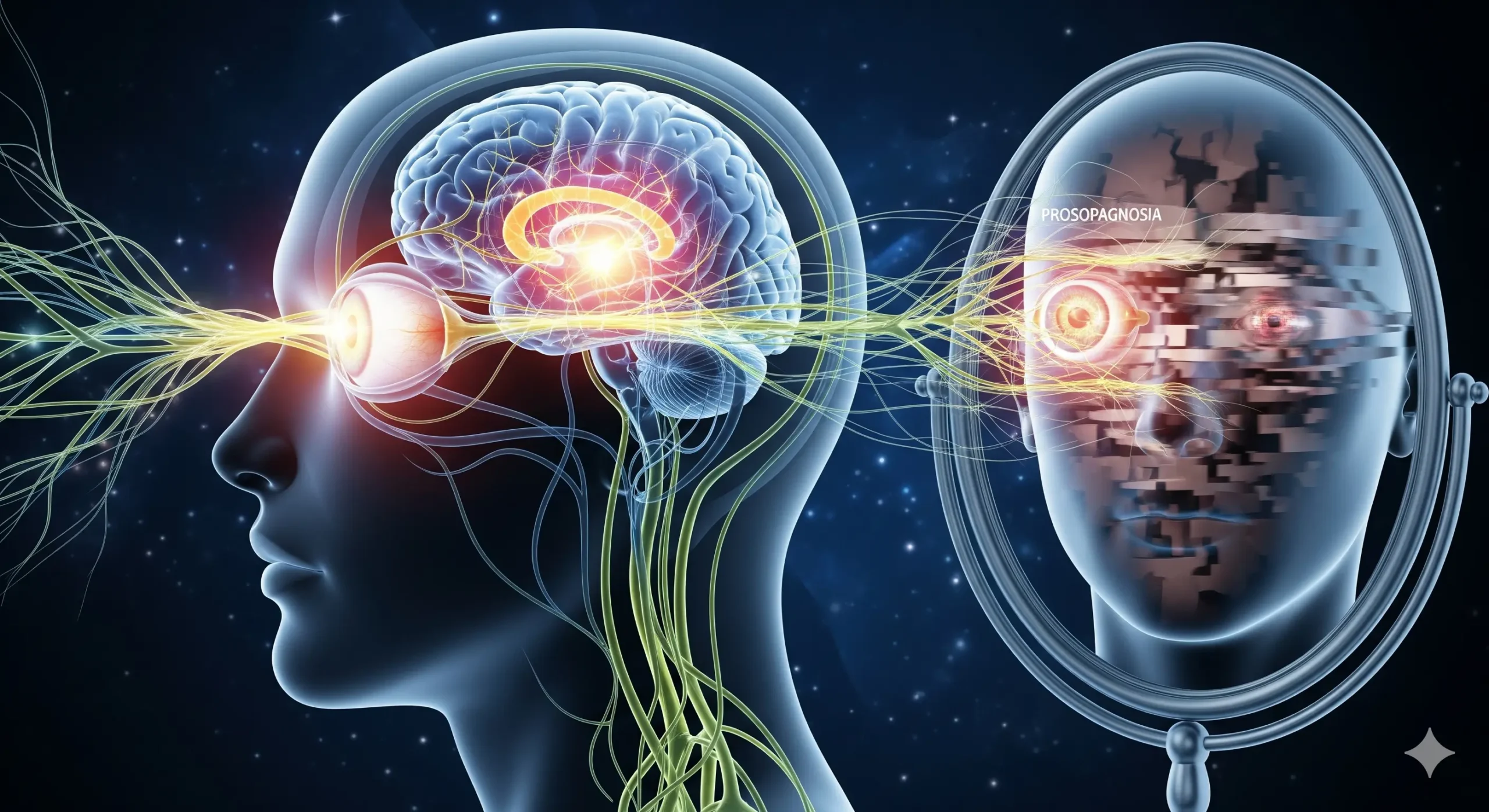
This isn’t a scene from a psychological thriller; it was the daily reality for Dr. Oliver Sacks, the brilliant neurologist and author. Despite his immense intellect, Dr. Sacks lived with prosopagnosia, also known as face blindness. He could recognize his coffee cup on a shelf, but he couldn’t distinguish his oldest friend in a crowd—or even his own face in a mirror.
Dr. Sacks’ condition offers us a profound window into a fundamental question in psychology: How do we actually experience the world?
As a psychologist, I often remind my clients that what we see isn’t always what is there. To understand the human experience, we must understand the delicate dance between sensation (the hardware) and perception (the software). Today, let’s dive into the neuroscience and psychology of how we make sense of our reality.
The Difference Between Sensing and Perceiving
We often use the words “sensing” and “perceiving” interchangeably, but in psychology, they represent two distinct processes.
Sensation is the bottom-up process. It is raw data. It’s your eyes taking in light, your ears picking up sound waves, or your nose detecting chemical molecules. It is the biology of receiving outside stimuli.
Perception, however, is the top-down process. It is how your brain organizes, interprets, and contextualizes that raw data.
Think of it this way:
- Sensation is your eyes detecting a specific wavelength of light bouncing off a screen.
- Perception is your brain telling you, “That is a video of a person teaching psychology,” or even recognizing that person as a specific individual.
In Dr. Sacks’ case, his sensation was perfectly intact. His eyes worked fine. The break occurred in his perception—specifically, the sliver of the brain responsible for processing facial geometry (the fusiform gyrus) was malfunctioning.
The Limits of Awareness: What We Filter Out
We are constantly bombarded by stimuli—traffic noise, the hum of a refrigerator, the pressure of clothes on our skin. If we paid attention to everything, we would be paralyzed by information overload. Fortunately, our brains are master editors.
The Absolute Threshold
Psychologists measure our sensitivity using the Absolute Threshold of Sensation. This is the minimum amount of stimulation needed for a person to detect a stimulus 50% of the time.
However, this threshold isn’t a fixed line in the sand. It fluctuates based on our psychological state, a concept known as Signal Detection Theory.
Consider the “Paranoid Parent” phenomenon. An exhausted new mother might sleep through the roar of a passing train but will wake up instantly at the tiniest whimper from her baby. Her senses haven’t become “better”; her brain has simply shifted its priorities based on context, alertness, and expectations.
Sensory Adaptation
Another protective mechanism is sensory adaptation. Have you ever panicked, thinking you lost your wallet or phone, only to realize it was in your pocket the whole time?
When we are exposed to constant, unchanging stimulation, our nerve cells fire less frequently. We stop “feeling” the wallet in our pocket so that our brain is free to focus on new and changing information. It’s a brilliant biological efficiency hack.
Weber’s Law: It’s All Relative
How much does a stimulus need to change for us to notice a difference? This is called the Difference Threshold, and it follows a principle known as Weber’s Law.
Weber’s Law states that to perceive a difference, two stimuli must differ by a constant percentage, not a constant amount.
- Example: If you are looking at two tiny, dim stars, you can easily tell if one is slightly brighter than the other. However, if you are looking at two massive, blazing stars, that same small difference in brightness will be invisible to you.
Our perception of the world is rarely linear; it is logarithmic and highly relative to the context.
The Miracle of Vision
Of all our senses, vision is perhaps the most complex. The journey from light wave to “seeing” is a lightning-fast neurological relay race.
Light travels in waves, and the properties of these waves dictate what we see:
- Wavelength (Frequency): Determines the hue (color). Short waves look blue; long waves look red.
- Amplitude (Height): Determines the intensity (brightness). Higher amplitude means brighter colors.
Rods and Cones: The Retinal Team
When light hits the back of your eye (the retina), it is processed by millions of receptor cells called rods and cones.
- Cones: These are your “high-definition” receptors. They cluster in the center of the retina (the fovea) and are responsible for seeing fine detail and color. They work best in bright light.
- Rods: These are your “night vision” receptors. They sit in the periphery of the retina. They can’t see color, but they are highly sensitive to movement and dim light—which is why you might see a vague shape moving in the dark out of the corner of your eye, but when you look directly at it, it disappears.
How We See Color
The average human can distinguish roughly one million different hues. We currently rely on two main theories to explain this:
- Young-Helmholtz Trichromatic Theory: This suggests we have three types of cones—red, green, and blue. All the colors we perceive are combinations of these three receptors firing.
- Opponent-Process Theory: This suggests we process color through opposing channels (red vs. green, blue vs. yellow). This explains why we can’t visualize “reddish-green”—the neurons for red are inhibited by green, and vice versa.
Parallel Processing: The Brain’s Symphony
Perhaps the most impressive feat of the brain is parallel processing. When you look at a scene—say, a friend waving at you—your brain doesn’t process the information linearly (first the shape, then the color, then the movement).
Instead, different parts of your visual cortex handle these tasks simultaneously.
- One area assesses color.
- Another analyzes motion.
- Another identifies depth.
- Another recognizes the form.
Your brain weaves these disparate threads together instantly to create a seamless, conscious experience: “That is my friend, they are wearing a red shirt, and they are happy to see me.”
Conclusion: Your Perception is Your Reality
Understanding sensation and perception reminds us that our experience of reality is a construction. From the light waves hitting our retinas to the psychological filters of Signal Detection Theory, we are active participants in creating our world.
For those of us in the mental health field, this is an empowering concept. It suggests that while we cannot always control the “input” (sensation) of our lives, we have profound influence over the “processing” (perception). Whether it is retraining our brain to notice the positive or understanding why we filter out certain information, the bridge between the eye and the mind is where the magic of human psychology happens.
Reflection Question
Have you ever experienced “sensory adaptation” in your emotional life? For example, getting so used to a stressful situation that you stopped noticing how heavy it felt until it was gone? Share your thoughts in the comments below.
Help Us Improve This Article
Have you discovered an inaccuracy? We put out great effort to give accurate and scientifically trustworthy information to our readers. Please notify us if you discover any typographical or grammatical errors.
Make a comment. We acknowledge and appreciate your efforts.
Share With Us
If you have any scale or any material related to psychology kindly share it with us at [email protected]. We help others on behalf of you.


