 Psychology Roots
The Chemistry of You: Unlocking the Secrets of Neurons, Hormones, and Your Mental Health
The “Bump in the Night” Phenomenon
It’s late at night. You are home alone, just drifting into a comfortable sleep, dreaming about your favorite snack. Suddenly—BANG!—there is a loud noise at the door.
In a split second, you are wide awake. Your heart feels like it’s going to pound right out of your chest. Your muscles tense up, and you are ready to either sprint out the back door or grab the nearest heavy object to defend yourself.
Whether that noise was a intruder or just your neighbor returning a borrowed tool doesn’t matter in that immediate moment. Why? Because your brain has already released an icy typhoon of chemicals.
As a psychologist, I often hear clients describe their moods, anxieties, and impulses as if they are purely abstract “mental” issues. But here is the fundamental truth we must embrace: Everything psychological is biological.
Your mood, your ideas, your sudden urge to run, and your ability to read this sentence right now are all biological processes. To truly understand our mental health, we have to look under the hood at the complex chemistry bubbling inside us.
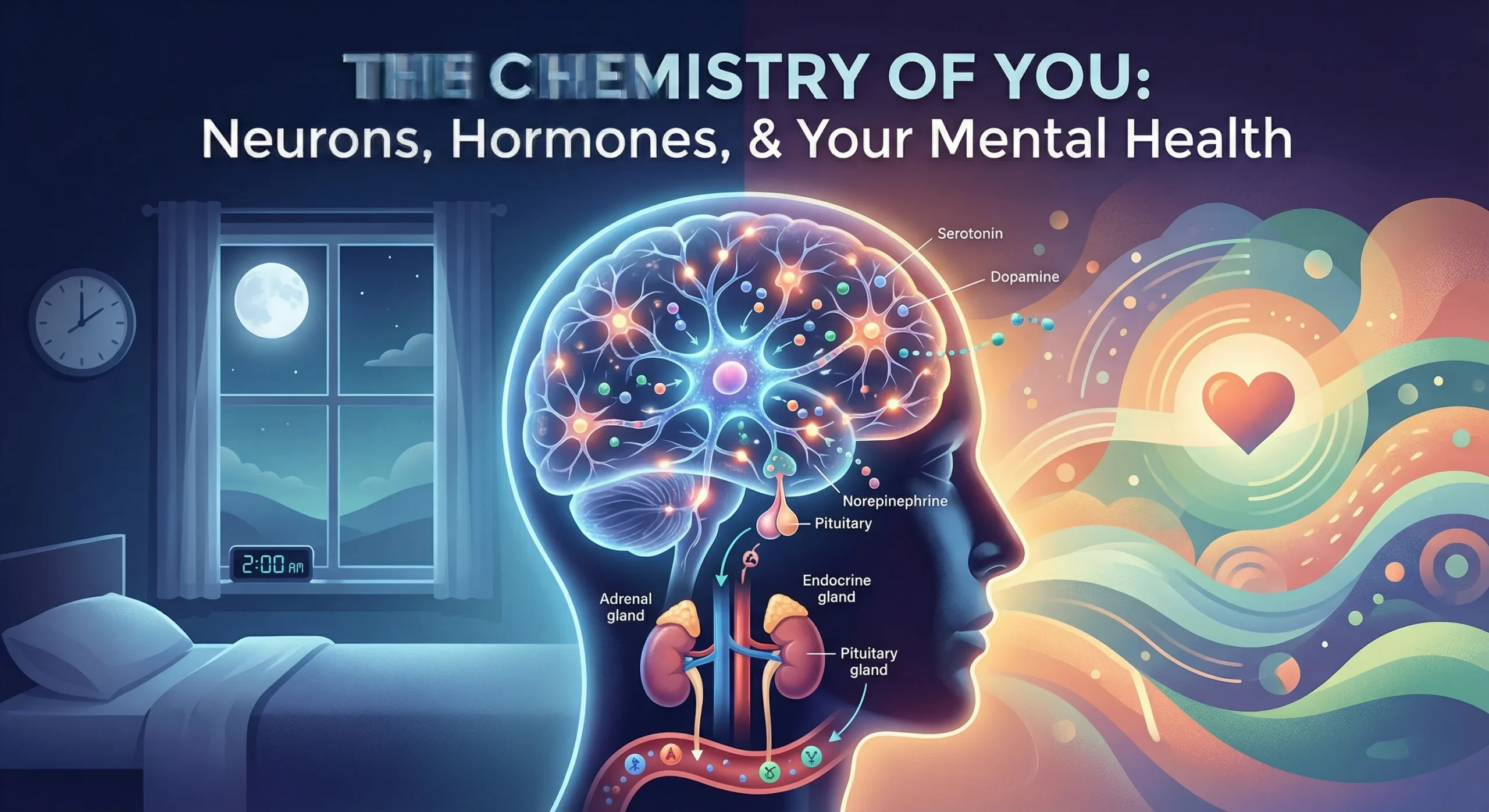
The Building Blocks: Meet Your Neurons
To understand why we feel the way we do, we have to start small. Really small. We need to talk about neurons.
Neurons are the nerve cells that make up your nervous system. Your brain alone houses billions of them. Unlike other cells in your body, neurons possess a special “electrochemical mojo” that allows them to transmit messages to one another.
Think of a neuron like a tree. It has three main parts:
- The Soma (Cell Body): This is the life support center, containing the DNA and nucleus. If this dies, the whole cell dies.
- The Dendrites: These are the bushy, branch-like listeners. They receive gossip and messages from other cells.
- The Axon: This is the trunk, the “talker.” It carries the electrical message away from the cell body to other neurons, muscles, or glands.
Some axons are encased in a fatty tissue called the myelin sheath. Think of this like the insulation on an electrical wire—it helps the signal travel faster. When this sheath degrades (as seen in conditions like Multiple Sclerosis), self-control over muscles and sensation begins to fade.
The Social Life of Cells: The Synapse
Here is where it gets fascinating. Neurons don’t actually touch. They are like siblings in the backseat of a car playing the “I’m not touching you” game. There is a microscopic gap between them called the synaptic gap.
When an electrical signal reaches the end of a neuron, it can’t jump the gap alone. It needs a vehicle. This is where neurotransmitters come in.
The Chemical Cocktail: Neurotransmitters
When a signal hits the end of an axon, it triggers the release of chemical messengers—neurotransmitters—which float across that tiny gap and bind to receptor sites on the next neuron, much like a key fitting into a specific lock.
Once they unlock the receptor, they trigger a reaction (excitement or inhibition). Afterward, the original neuron often sucks the excess chemicals back up in a process called reuptake.
There are over 100 different types of these chemicals, and they dictate everything from your sleep patterns to your ability to fall in love. Let’s look at the heavy hitters that often come up in therapy:
1. The Mood Regulators
- Serotonin: You’ve likely heard of this one. It regulates mood, hunger, and sleep. Low levels of serotonin are strongly linked to depression. This is why a common class of antidepressants (SSRIs) works by blocking the reuptake of serotonin, leaving more of it available in your brain to lift your mood.
- Dopamine: The “reward” chemical. It is associated with learning, movement, and pleasurable emotions. However, it’s a double-edged sword; excessive dopamine is linked to schizophrenia, while the pursuit of dopamine hits is a core component of addiction.
2. The Accelerators and Brakes
- Norepinephrine: This helps control alertness and arousal. It’s the fuel for your focus.
- GABA (Gamma-aminobutyric acid): This is a major inhibitory neurotransmitter. Think of it as nature’s Valium—it calms the firing of neurons.
- Glutamate: The opposite of GABA, this is involved in memory. However, too much can “wig out” the brain and cause migraines or seizures (which is why some people are sensitive to MSG in food).
The Slow Burn: Hormones and the Endocrine System
While neurons are zapping messages at lightning speed, your body has a second communication system that is just as important for your mental state: the Endocrine System.
If the nervous system is like sending a text message (instant, direct), the endocrine system is like writing a letter, putting it in an envelope, stamping it, and mailing it. It’s slower, but the message lasts longer.
This system uses hormones, which are secreted by glands into the bloodstream.
- The Adrenal Glands: Located near your kidneys, these release adrenaline (epinephrine). This triggers the “fight or flight” response—increasing heart rate and blood sugar to give you a surge of energy.
- The Pituitary Gland: The “master gland” in your brain. It releases growth hormones and oxytocin, the bonding hormone that creates feelings of trust and connection when you hug someone or bond with a baby.
Because hormones linger in the bloodstream, they explain why you might still feel shaky or upset twenty minutes after a scare has passed. The “text message” of the scare is over, but the “letter” is still being read by your body.
Why This Matters for Your Mental Health
Understanding the biology of the brain isn’t just academic; it is deeply empowering.
When you feel a sudden surge of anxiety, it helps to realize: “I am not ‘crazy.’ My amygdala signaled my adrenal glands, and I am currently awash in cortisol and adrenaline.”
When you feel sluggish or depressed, it helps to know that your serotonin levels might be fluctuating, or your circadian rhythms (controlled by hormones) are out of sync.
Our nervous system and endocrine system are constantly talking to each other in a complex feedback loop. Your brain perceives a threat, tells the glands to release hormones, those hormones affect the body, and the brain reads those body changes and decides whether to calm down or panic further.
A Note on “Just Chemistry”
While we are biological beings, we are not just robots programmed by chemicals. Our experiences, our relationships, and our therapy can actually change our biology. Learning new things creates new neural pathways. engaging in calming practices can lower cortisol levels.
We are a magnificent mix of electricity, chemistry, and consciousness.
Reflection
Think about the last time you felt a strong emotion—fear, joy, or anger. Can you identify the physical sensations that came with it? That was your endocrine system at work. How might viewing your emotions as “biological events” change how you treat yourself when you’re feeling overwhelmed?
Help Us Improve This Article
Have you discovered an inaccuracy? We put out great effort to give accurate and scientifically trustworthy information to our readers. Please notify us if you discover any typographical or grammatical errors.
Make a comment. We acknowledge and appreciate your efforts.
Share With Us
If you have any scale or any material related to psychology kindly share it with us at [email protected]. We help others on behalf of you.


