 Psychology Roots
Sleeping Smarter, Not Longer: The Psychological Science of Efficient Rest
It’s 3:00 AM. The blue light of your phone illuminates a face etched with a familiar mix of exhaustion and frustration. You promised yourself you’d be asleep hours ago, but you fell down a rabbit hole of “just one more video”.
When your 6:00 AM alarm rings, it feels like a personal attack. You drag yourself out of bed, your eyes burning, your mind wrapped in a thick fog. You murmur the sleep-deprived person’s mantra: “I’ll sleep early tomorrow.”
But tomorrow, the cycle repeats.
As a psychologist, I see this pattern constantly. It’s a modern epidemic of “tired-but-wired” exhaustion. What makes this frustration even greater is the cultural narrative we’re fed. We see high-performing entrepreneurs, athletes, and online personalities who claim to thrive on just five or six hours of sleep.
How do they do it, while the rest of us feel biologically broken after anything less than eight?
This disparity can create significant “sleep anxiety”—the fear that we are failing at a basic human function. But what if I told you the answer isn’t about how long you sleep, but how well you sleep?
The secret doesn’t lie in the quantity of hours spent in bed; it lies in the quality and efficiency of your sleep architecture. Today, we’re moving past the “hustle culture” myth of sleep deprivation and into the science of profound, efficient rest.
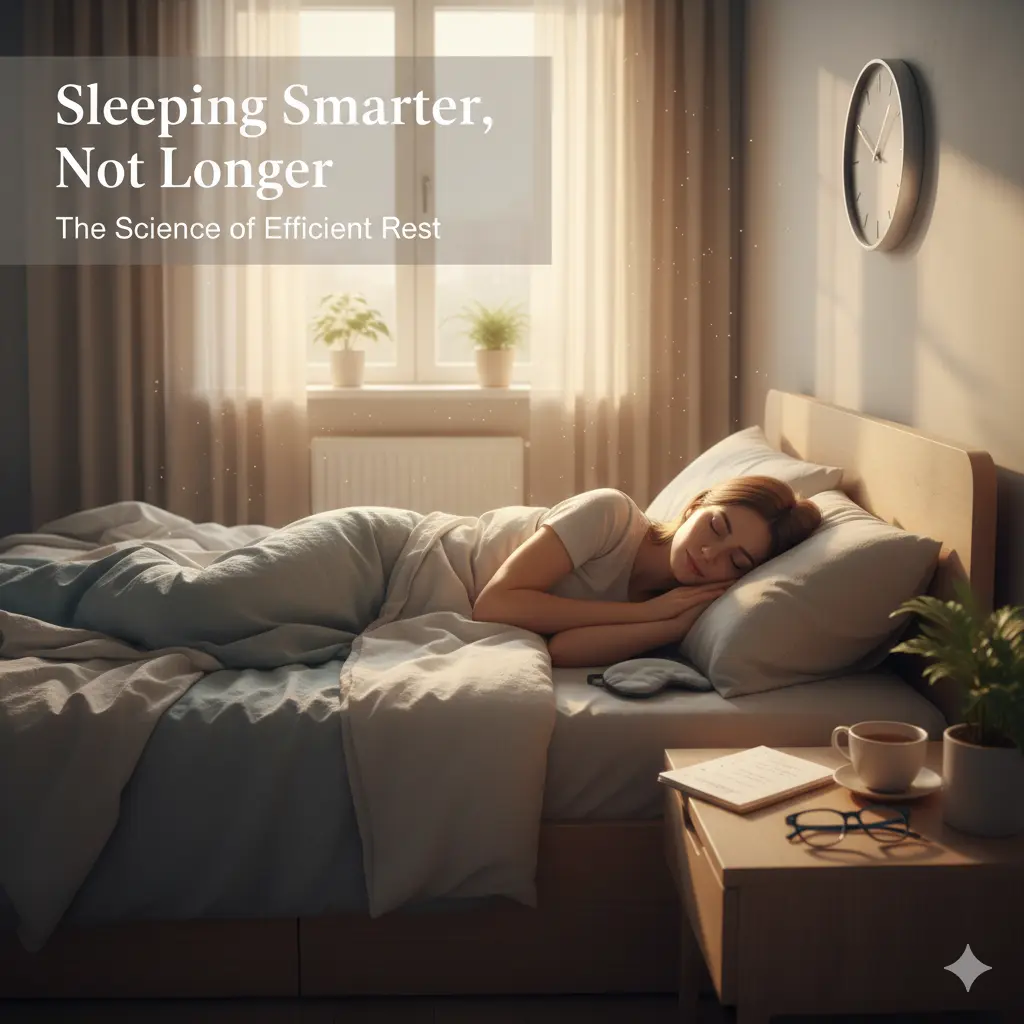
The 8-Hour Myth: Why More Sleep Doesn’t Mean Better Rest
For decades, we’ve been told that eight hours is the gold standard for sleep. While this is a good average, it’s a blunt instrument. It fails to account for the most critical factor: your sleep cycles.
You can sleep for nine hours and wake up feeling like you’ve been hit by a truck if that sleep was fragmented, shallow, and interrupted by stress, caffeine, or blue light. Conversely, you can sleep for six focused, uninterrupted hours and wake up feeling sharp, recharged, and clear.
The goal is not more time; it’s more restoration per hour.
Understanding Your Sleep Architecture: Deep vs. REM
Your brain doesn’t just “turn off” when you sleep. It cycles through complex, active stages. Each full cycle lasts approximately 90 minutes and is composed of several stages, but the two most crucial for restoration are Deep Sleep and REM Sleep.
- Deep Sleep (Stage 3): This is your physical restoration phase. Your body repairs muscle, strengthens your immune system, and recharges its physical energy. Waking from this stage is what causes that profound, concrete-like grogginess.
- REM (Rapid Eye Movement) Sleep: This is your psychological restoration phase. Your brain consolidates memories, processes emotions, and enhances creativity and focus. It’s during REM that your mind “files away” the experiences of the day, which is why poor REM sleep is often linked to anxiety and mood disorders.
When your sleep is efficient, your brain seamlessly navigates these cycles, maximizing the time spent in these two critical, restorative states.
The Chrono-Consistency Protocol: Aligning Your Internal Clock
If you want to improve your sleep efficiency, your first and most powerful tool is not a pill or a gadget—it’s a schedule.
The Power of the Circadian Rhythm
Your body runs on an internal 24-hour clock called the circadian rhythm. This rhythm governs everything from your hunger to your hormone release. When you go to bed and wake up at the same time every day—yes, even on weekends—you “train” this rhythm.
A consistent schedule teaches your brain to release melatonin (the sleep hormone) at the right time and cortisol (the wake-up hormone) at the right time. Research from institutions like Stanford University has shown that irregular sleep schedules confuse the brain, leading to shallower, less effective sleep.
The Action: Choose a fixed wake time and stick to it. For example, 11:00 PM to 5:30 AM. Within a week, your body will learn this rhythm, and waking up will feel dramatically less painful.
The 90-Minute Rule: Waking Up Refreshed
Have you ever wondered why you sometimes feel great on 6 hours of sleep but terrible on 7? You likely woke up at the end of a 90-minute cycle instead of in the middle of one.
Waking up during deep sleep causes a powerful grogginess called “sleep inertia.” You can avoid this by planning your sleep in 90-minute blocks.
- 3 Cycles: 4.5 hours
- 4 Cycles: 6 hours
- 5 Cycles: 7.5 hours
Set your alarm for one of these totals. This simple change aligns your wake-up time with your brain’s natural rhythm, allowing you to wake up feeling aware and alert.
Preparing the Mind for Rest: The Pre-Sleep Shutdown
You can’t expect your brain to go from 100 mph to a dead stop. The hour before bed is not just “waiting for sleep”; it is the preparation for sleep. In cognitive behavioral therapy for insomnia (CBT-I), we call this a “wind-down routine.”
A great framework to use is the 3-2-1 Method:
- 3 Hours Before Bed: No Heavy Meals. Digestion requires significant energy and can disrupt the body’s ability to cool down, a process essential for initiating sleep.
- 2 Hours Before Bed: No More Work. This is about cognitive disengagement. Answering emails or stressing about tomorrow’s to-do list keeps your brain in an active, “beta wave” state, which is the opposite of the “alpha wave” state needed for rest.
- 1 Hour Before Bed: No Screens. This is non-negotiable. The blue light from phones, tablets, and TVs directly inhibits your brain’s production of melatonin.
Replace that screen time with activities that signal safety and rest to your nervous system: dim warm lights, light stretching, meditation, or listening to a calm playlist.
The “Mental Declutter” (A Core CBT-I Technique)
If you lie down only to have your mind flooded with a racing list of worries and tasks, you must get them out.
Keep a notebook by your bed. Before you lie down, perform a “brain dump.” Write down every single to-do, worry, or idea. This externalizes your thoughts, effectively giving your brain permission to let go of them until morning. This practice is one of the most effective ways to quiet a racing mind and transition into the calm, “theta wave” state required for deep sleep.
Starting Strong: How to Wake Up with Energy
What you do in the first 10 minutes of your day dictates your energy for the next 10 hours.
The Sunlight Signal
Do not reach for your phone first thing. Instead, for 10 minutes, expose your eyes to direct, natural sunlight.
This morning light is a powerful biological trigger. It instantly:
- Suppresses Melatonin: Telling your body “sleep is over.”
- Resets Your Circadian Rhythm: Locking in your schedule for the day.
- Boosts Serotonin: A neurotransmitter crucial for mood, motivation, and alertness.
You will literally feel your brain wake up.
Action Over Apathy: Beating Sleep Inertia
Don’t hit the snooze button. That fragmented, 9-minute “extra sleep” is low-quality and only makes you feel groggier.
Instead, hit action. Immediately get up and create a small amount of physiological stress to wake your system.
- Wash your face with cold water.
- Do 20 push-ups or jumping jacks.
This small burst of movement raises your heart rate and boosts the release of dopamine and noradrenaline, your brain’s natural stimulants. This will clear the remaining sleep inertia in minutes.
Fine-Tuning Your Biology and Environment
If you have the foundations in place, these “advanced” tips can further optimize your sleep quality.
- The Caffeine Curfew: Caffeine works by blocking adenosine, the chemical in your brain that builds up all day to create “sleep pressure”. Caffeine has a half-life of 6-8 hours. That means if you have a coffee at 3 PM, a significant portion is still in your system at 9 PM. Even if you can fall asleep, studies show late-day caffeine can reduce your deep sleep by up to 30%. Make 2 PM your absolute cut-off.
- The Sleep Sanctuary: Your brain needs specific environmental cues to enter deep sleep. Make your room dark, cold, and quiet. The ideal temperature for sleep is surprisingly low, around 18-20°C (65-68°F). Use blackout curtains or a sleep mask.
- Nutritional Support (with a Caveat): Some supplements are known to support the nervous system. Magnesium (specifically Magnesium Glycinate) can have a calming effect and support sleep quality. Herbal teas like ashwagandha can also help. However, you must consult your doctor or a medical professional before beginning any new supplement regimen.
The Mindset Shift: Sleep is Not Weakness
I want to leave you with a final, crucial psychological shift. For too long, “hustle culture” has framed sleep as a weakness or a luxury—a waste of time that could be spent “grinding.”
This is scientifically and psychologically false.
Sleep is not a passive weakness; it is an active and essential performance tool. It is the non-negotiable foundation of your mental health, emotional regulation, and cognitive focus.
You cannot pour from an empty cup. By optimizing your sleep, you are not losing time; you are gaining energy, clarity, and life. You are making the hours you are awake infinitely more effective.
You don’t need more time. You just need better energy.
Reflection Question: What is one small change you can make to your pre-sleep ritual tonight to signal to your mind and body that it is time for quality rest?
Help Us Improve This Article
Have you discovered an inaccuracy? We put out great effort to give accurate and scientifically trustworthy information to our readers. Please notify us if you discover any typographical or grammatical errors.
Make a comment. We acknowledge and appreciate your efforts.
Share With Us
If you have any scale or any material related to psychology kindly share it with us at [email protected]. We help others on behalf of you.


