 Psychology Roots
Why Your Gut Feeling Might Be Wrong: The Surprising Science Behind Psychological Research
Have you ever watched a friend make a questionable life choice—like eating week-old pizza or texting an ex—and when it inevitably backfired, you smugly thought, “I knew that was going to happen”?
We all do it. We are humans, and because we live inside the human experience, we often feel like we are experts on what makes people tick. We rely on “common sense” or gut feelings to explain why people act the way they do.
But here is the uncomfortable truth I often share with my clients: Your intuition is frequently wrong.
As a psychologist, I spend a lot of time helping people unlearn the narratives they’ve constructed based on false intuition. In the world of mental health and psychology, relying on “hunches” isn’t just inaccurate; it can be dangerous. This is why psychology isn’t just about listening to feelings—it is a rigorous science dedicated to saving us from the stupidity of our own minds.
In this post, we are going to explore why your brain lies to you, and how psychological research acts as the flashlight in the dark room of human behavior.
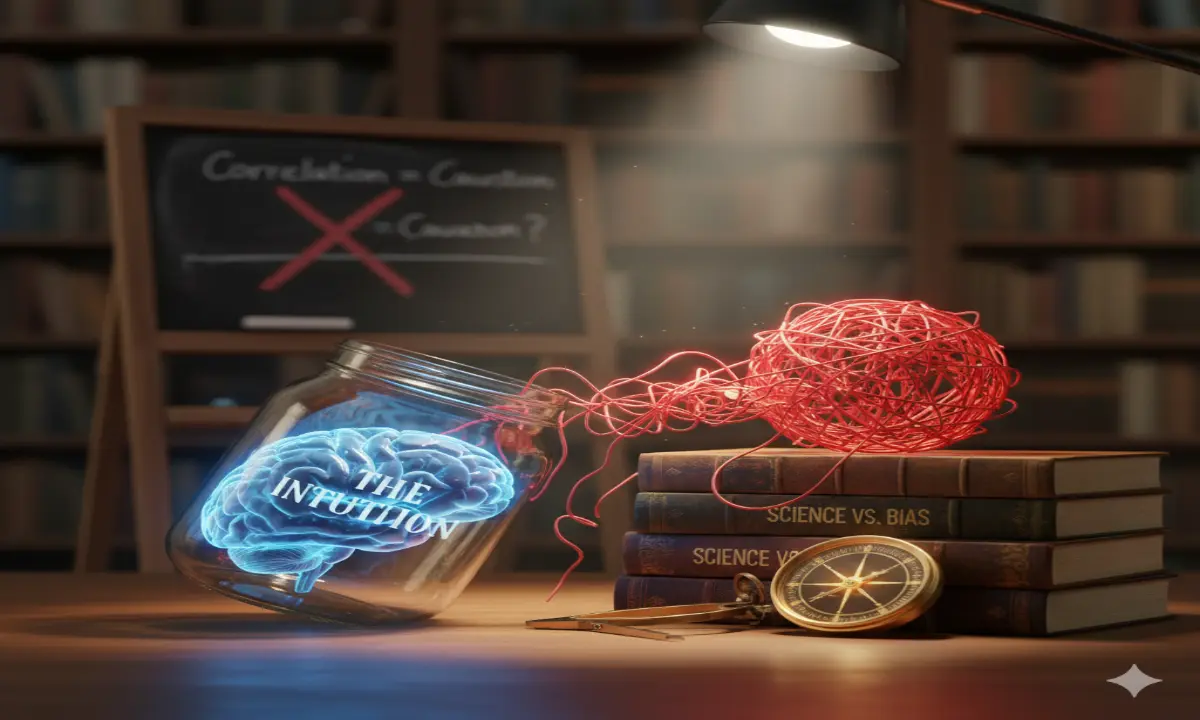
The Mirage of Hindsight Bias
The most common trap we fall into is something researchers call Hindsight Bias, also known as the “I-Knew-It-All-Along” phenomenon.
When an event happens, our brains immediately scramble to make sense of it. If your friend gets sick after that old pizza, you tell yourself you foresaw it. But if he had eaten it and felt fine? You likely wouldn’t have remembered the event at all.
Our intuition is fantastic at describing what just happened, but it is terrible at predicting what will happen.
We also tend to see order in random events. If you flip a coin and get five tails in a row, your brain screams, “A pattern! The next one must be heads!” But it’s not a pattern; it’s just randomness. We crave narrative so deeply that we invent connections where none exist.
This is where The Scientific Method steps in. It forces us to move from “I feel like this is true” to “Let’s prove if this is true.”
How Psychologists Actually Study the Mind
Psychology isn’t just people sitting on couches guessing about dreams. It requires operationalizing questions—taking a vague idea (like “coffee makes me smart”) and turning it into a measurable test.
To understand human behavior without bias, we use a specific toolkit. Let’s break down the three major ways we gather intel on the human mind.
1. The Case Study: The Power of the Individual
A case study is a deep dive into one person. Think of it like a biography. These are fascinating and often make for great storytelling.
- The Pro: They show us what is possible. (e.g., “Carl gets anxious when he smells coffee”).
- The Con: They cannot be replicated. Just because Carl hates coffee doesn’t mean coffee causes anxiety in everyone.
- The Takeaway: Case studies act as inspiration for further research, but we can never generalize a whole population based on one person’s story.
2. Naturalistic Observation: The “People Watching” Method
Sometimes, to understand behavior, you have to watch it in the wild. Whether it’s researchers watching children play in a classroom or observing how people react to a dropped wallet on the street.
- The Goal: To observe behavior without manipulating it.
- The Limit: It describes what is happening, but it rarely explains why.
3. Surveys and Interviews: Asking the Right Questions
If you want to know what people think, why not just ask them? Surveys are great for gathering massive amounts of data, but they are tricky.
The Wording Effect: How I ask you a question changes your answer.
- Question A: “Do you support censoring media?” (Most say no).
- Question B: “Do you support limiting explicit content for children?” (Most say yes).
It is the same core concept, but the phrasing dictates the result. Furthermore, who we ask matters. If I only ask college students about stress, I cannot claim to understand the stress of a retired veteran. This is why Random Sampling—giving everyone in a population an equal chance of being chosen—is non-negotiable for accurate results.
The Golden Rule: Correlation is Not Causation
If there is one phrase you take away from this article, let it be this.
Imagine we find that people who eat “questionable leftovers” hallucinate more often.
- Variable A: Eating bad food.
- Variable B: Hallucinations.
We see a correlation (a relationship). But does A cause B? Not necessarily. Perhaps the person was already sleep-deprived (Variable C), which caused them to be too lazy to cook fresh food and caused the hallucinations.
In mental health, we see this constantly. Does social media cause depression? Or do depressed people use social media more? We can predict a relationship, but we cannot prove cause-and-effect without an experiment.
The Experiment: Finding the Truth
To truly know if coffee makes you smarter (or just faster at making mistakes), we have to run an Experiment. This is the only method that isolates cause and effect.
Here is how a psychologist would set this up:
- Hypothesis: “Adults given 200mg of caffeine will navigate a maze faster than those without.”
- Control Group: These people get decaf (a placebo). They serve as the baseline.
- Experimental Group: These people get the caffeine.
- Double-Blind: Ideally, neither the participants nor the researchers know who has the real caffeine until the end. This prevents the researcher from accidentally smiling more at the “caffeinated” group and influencing the results.
If the caffeinated group consistently solves the maze faster, only then can we say, “Caffeine improves maze-solving speed.”
Why This Matters to You
You might be thinking, “I’m not a researcher, why do I care about double-blind studies?”
You care because you are a consumer of information. Every day, headlines scream “Science Says X Cures Anxiety” or “Study Shows Y Makes You Happy.” Understanding the basics of psychological research acts as a shield. It helps you ask:
- Was this a real experiment or just a survey?
- Are they confusing correlation with causation?
- Is this a general truth, or just a unique case study?
Final Thoughts: Embrace the Skeptic
Science is, at its heart, the best tool we have for understanding others. It saves us from our own biases and helps us see the world not as we feel it is, but as it actually is.
Next time you feel 100% certain about why someone is acting the way they are, pause. Ask yourself: Is this evidence, or is this just my intuition speaking?
Reflective Question
Can you think of a time when your “gut feeling” about a person turned out to be completely wrong? How did that change how you viewed your own intuition? Let me know in the comments below.
Help Us Improve This Article
Have you discovered an inaccuracy? We put out great effort to give accurate and scientifically trustworthy information to our readers. Please notify us if you discover any typographical or grammatical errors.
Make a comment. We acknowledge and appreciate your efforts.
Share With Us
If you have any scale or any material related to psychology kindly share it with us at [email protected]. We help others on behalf of you.


