 Psychology Roots
Healing from Trauma: 5 Common Mistakes That Keep You Stuck (And How to Fix Them)
Have you ever felt like you are an expert on your own history? You know exactly what happened to you, you understand why your parents acted the way they did, and you can analyze your triggers with the precision of a surgeon. Yet, despite all that intellectual understanding, the panic attacks still come. The shame still lingers. The body still freezes.
If this sounds familiar, you aren’t broken, and you aren’t failing at therapy. You might just be caught in one of the common traps of trauma recovery.
Healing is messy, non-linear work. In a recent deep-dive conversation with trauma expert Dr. Frank Anderson, we explored the subtle but significant roadblocks that prevent true recovery. Here is how to identify if you are stuck in a cycle of “management” rather than true healing—and how to break free.
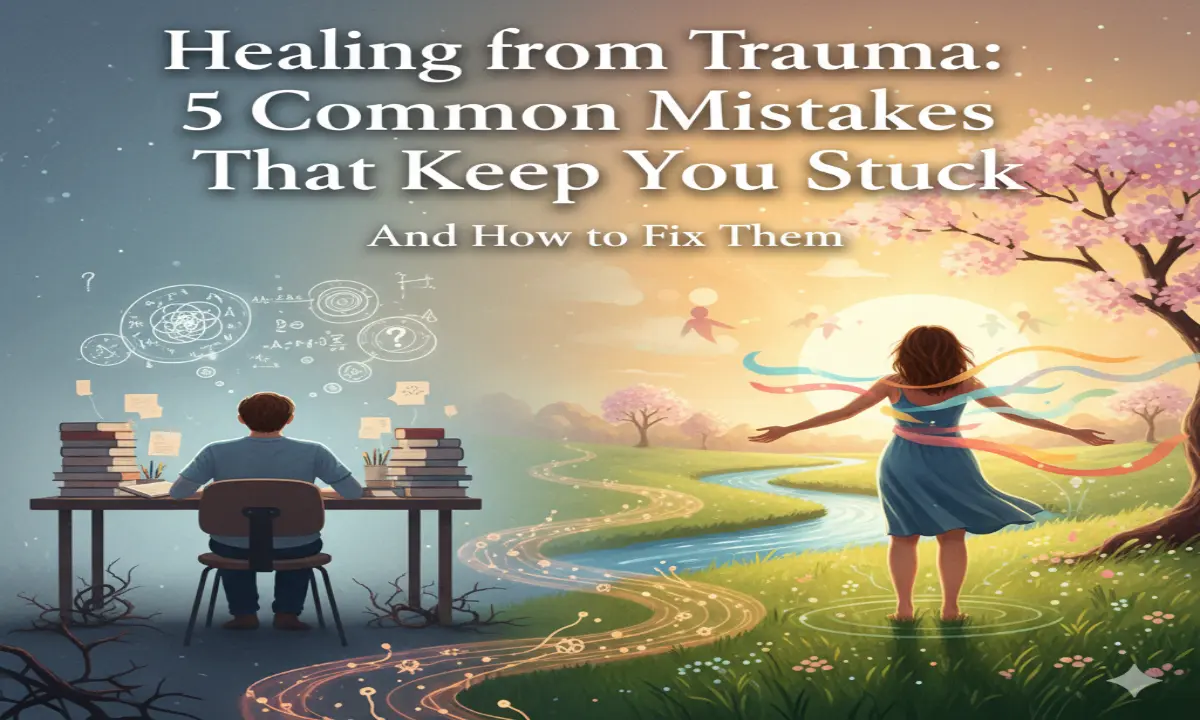
Mistake #1: Trying to “Think” Your Way Out of Trauma
We live in a logic-obsessed world. We assume that if we can just figure out the problem, we can solve it. But when it comes to trauma, your prefrontal cortex (the thinking brain) isn’t the captain of the ship.
Dr. Frank Anderson notes that insight is helpful, but it is a “helper, not a solver”. You can analyze your trauma for ten years, five times a week, and still hold the terror in your nervous system.
Why this happens: When we experience something overwhelming, especially as children, we naturally try to “make sense” of it to survive. We fill in the blanks. This is adaptive. But trauma affects the neural networks in your body and emotions, not just your cognitive brain.
The Solution: You have to move from cognitive processing to experiential therapy.
- Thank your thinker: Acknowledge that your brain is trying to protect you.
- Access the body: Engage in therapies that access the emotional world and body sensations (like Somatic Experiencing or EMDR) rather than just talk therapy.
Mistake #2: Distracting Yourself from Triggers
It is a natural human instinct to move away from pain. In today’s world, we have endless tools for distraction—phones, work, food, and substances. While distraction offers temporary relief, ignoring your triggers (or “activations”) can actually make you physically sick.
Dr. Anderson warns that “when it’s intense, it’s yours”. An intense emotional reaction is a signal that unprocessed trauma energy is bubbling up. If we suppress it, that energy doesn’t vanish; it gets channeled into the body. This suppression is increasingly linked to autoimmune disorders, asthma, and chronic pain conditions.
The Shift: Instead of running from the activation, try to view it as data.
- Don’t Relive, Revisit: The goal isn’t to drown in the past. It is to take a “little overnight bag and visit” the feeling to understand what it is trying to tell you.
- Check your “Buffers”: Are you using work, OCD tendencies, or eating habits to keep yourself so busy that you don’t have time to feel?
Mistake #3: Ignoring the Body (Somatic Avoidance)
This ties closely to the first mistake. We often try to heal trauma from the neck up, but trauma is a physiological issue.
In trauma, the structures of the brain that integrate body awareness (like the insula) can actually shut down or become altered. We lose the capacity to process information integratively, so the fear gets encoded intensely in the amygdala (the fear center) and stuck in the body.
How to Reconnect: You cannot force deep trauma work if your body doesn’t feel safe.
- Establish Safety First: Before diving into the memories, you must learn how to create a sense of safety within your physical self.
- Release the Energy: Understand that the shaking, the tension, or the pain is energy that “doesn’t belong to you that you were forced to carry”.
Mistake #4: Minimizing or Comparing Your Trauma
“My parents didn’t hit me, so I shouldn’t feel this bad.” “Others have it so much worse, I have no right to complain.”
Comparing trauma is a survival strategy designed to minimize pain, but it often leads to gaslighting your own experience. Dr. Anderson explains that two people can experience the exact same event but have entirely different outcomes based on their perception and sensitivity.
One sibling might become an over-achiever to gain control, while the other shuts down completely. Neither reaction is “better” or “worse”—they are just different adaptations to the same lack of safety.
The Truth: Minimizing your pain prevents you from validating it. And if you cannot validate it, you cannot heal it. It doesn’t matter what happened “on paper”; what matters is what it did to you and how your system perceived it at the time.
Mistake #5: Shaming Yourself for Struggling
Perhaps the most pervasive mistake is the belief that “I am struggling because I am bad.” This is the voice of the Inner Critic.
In the Internal Family Systems (IFS) model, we understand that the Critic or the “Shamer” is actually trying to help you. It likely learned early on that if it shamed you into behaving correctly, you wouldn’t get yelled at or hurt by a parent.
A New Approach to the Inner Critic: Dr. Anderson suggests a radical approach: Love up the critic.
- Acknowledge the intention: Ask the part of you that is shaming you, “Are you trying to help me?”
- Ask the origin: “Where did you learn to help in this way?”
- Negotiate: Once that part feels understood, ask, “Are you interested in helping me in a different way?”.
Shame shuts down healing. Curiosity opens it up.
The “Secret” Ingredient: The Aftermath
If you take one thing away from this reading, let it be this: The severity of trauma is often determined not by the event itself, but by what happens immediately after.
Dr. Anderson shared a profound insight: “Trauma blocks love and connection, and it’s love and connection that heals trauma”.
If a child goes through something scary but is immediately met with a parent who says, “This sucks, I am here with you, I’ve got you,” the trauma is processed. It doesn’t get stuck. If you are on a healing journey now, seek out those “corrective relational experiences.” You don’t have to do this in isolation. Whether it is a therapist, a partner, or a friend—healing happens in connection.
Reflection
Take a moment to scan your body right now. Are you holding tension in your jaw or shoulders? If you stopped “thinking” about your problems for five minutes and just allowed yourself to feel the sensations in your body, what would they say?
Help Us Improve This Article
Have you discovered an inaccuracy? We put out great effort to give accurate and scientifically trustworthy information to our readers. Please notify us if you discover any typographical or grammatical errors.
Make a comment. We acknowledge and appreciate your efforts.
Share With Us
If you have any scale or any material related to psychology kindly share it with us at [email protected]. We help others on behalf of you.


